
Our website uses cookies to enhance your browsing experience.

Webinar: Let's make a programming language. Lexer - 29.04

PVS-Studio 7.41 has been released. It brings improvements for Unreal Engine, support for MISRA C 2023, an update to the IntelliJ IDEA plugin, and other useful changes. See more details in this note.
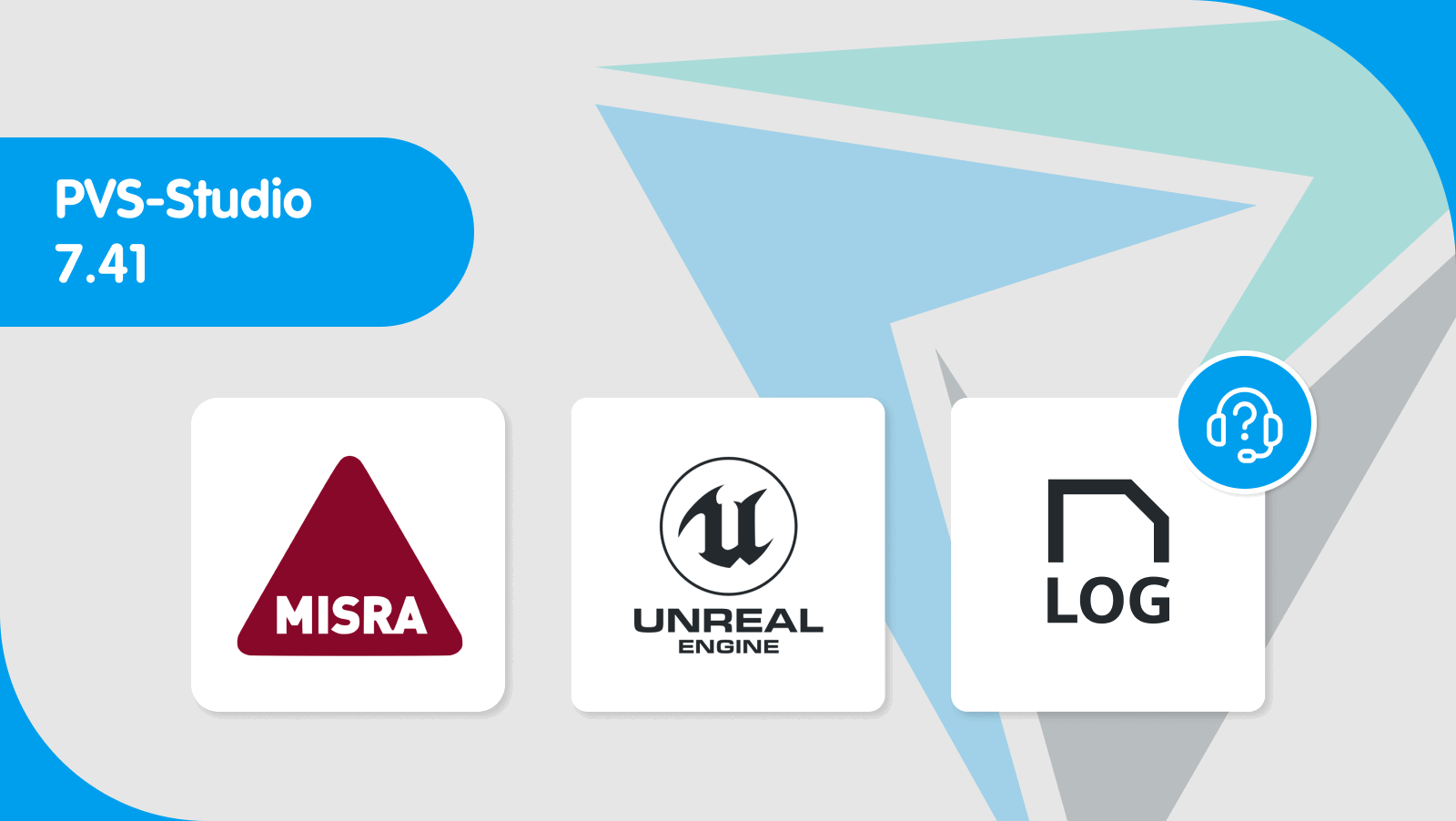
Throughout the year, we have been working to cover more of the MISRA C 2023 standard. Currently, PVS-Studio analyzer covers 86% of the standard. You can find more information on this page.
In future releases, we will continue to expand MISRA C++ 2023 standard coverage.
We continue to enhance how PVS-Studio handles Unreal Engine project code.
In this release, we improved the C++ analyzer's diagnostic capabilities for these projects. We fixed issues in the V557 diagnostic rule when working with engine containers, as well as a problem with parsing the final specifier in virtual functions.
For more details on how PVS-Studio works with Unreal Engine, refer to the documentation.
We expanded taint analysis support in the C# analyzer. Now you can add JSON user annotations for async functions. We also annotated async methods in standard library classes.
With the user annotation mechanism, you can provide the analyzer with additional context via a JSON file. We introduced this feature for the C# analyzer in PVS-Studio 7.33. For more details on how it works, refer to the documentation.
A new utility, pvs-fp-cleaner, is now included in PVS-Studio distributions. It removes redundant false alarm markers from the codebase.
False alarm markers are code comments that indicate to the analyzer that a triggered diagnostic rule on a specific line is a false positive and should not appear in the report. Previously, removing these markers required a manual review of the entire codebase.
For more details on the new utility, refer to the documentation.
Starting with this release, we are introducing a new logging system.
This system streamlines the process of collecting information about issues encountered when using PVS-Studio analyzers, thereby simplifying the technical support process.
The first stage involved adding extended logging for the C and C++ cross-platform analyzer. In the next release, we plan to extend logging for the analyzer of C++ and C# projects based on the MSBuild build system.
For more details on the new logging system, refer to the documentation.
We are constantly improving our IDE plugins to streamline the user experience of the analyzer during development.
This release enhances the IntelliJ IDEA plugin with the capability to convert analyzer reports to CSV format and the option to display relative paths. We also fixed the slowdown when opening documentation.
For more information on how the IntelliJ IDEA plugin works, refer to the documentation .
These changes are not backward compatible with earlier versions of the analyzer. You may need to adjust how you use the analyzer due to these changes.
Here's our usual roundup of blog posts. Over the past two months, we have published articles covering the best bugs in C++, C#, and Java for 2025. We have also explained alignment intricacies and discussed how dangerous Minecraft mods can compromise server security. You can find a full list of articles on different topics below.
If you would like to get news on latest releases, subscribe to our newsletter here.
If you haven't yet checked your project using PVS-Studio, you can start by getting a trial license.


0
0
0
 281
281
 0
32
0
41
0
0
32
0
41
0


0