
Our website uses cookies to enhance your browsing experience.


This article focuses on the methodology of static code analysis and its role in streamlining the time to market for software products. Let's think about how relevant it is to ask about the value of static analysis. We'll explore how it works alongside other software quality assurance practices. Integrating static analysis into the development process is not an overhead—it's an investment that pays for itself through early defect detection.

You might have heard the question: "How does static analysis get a product to market faster?". Phrased like that, the answer is disappointing: static analysis by itself does not speed up market entry—it takes time to introduce static analysis and handle warnings. But the real issue is that the question itself is flawed—much like asking whether the testing phase speeds up a product release.
The right question to ask is: "How does static analysis reduce time to market when shipping products at a given level of quality and reliability?". This framing reveals the methodology's core value.
"Counter-intuitively, adding quality checks accelerates development cycles rather than slowing them down. When developers have confidence that their changes won't break architectural constraints or introduce subtle bugs, they can work more boldly and efficiently" [1]
The testing analogy is particularly telling. No one asks whether testing speeds up a product release—everyone understands it's a necessary quality assurance step. Yet, in theory, the fastest way to launch a product is to write some working code and deploy it to production right away.
But in practice, nobody even thinks about shortening the testing phase. More often, we see that testing alone isn't enough.
According to the research, poor software quality costs the US economy over $2 trillion annually [2]. In such projects, up to 50% of effort goes into fixing bugs instead of creating business value [3].
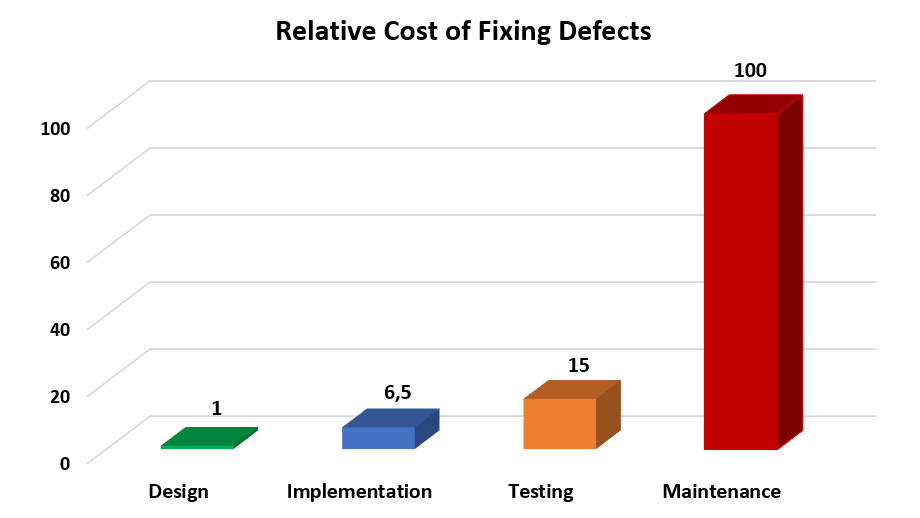
Figure 1. According to IBM System Science Institute — Relative cost of fixing defects.
The exponential growth in the cost of fixing a defect at later development stages is the key principle that explains the value of static analysis. According to the IBM Systems Science Institute, fixing a bug during testing might cost 2–3 times more than fixing it at the implementation (coding) stage. After the release, fixing that same bug costs 6 times more than during testing, and 15 times more than during implementation [4].
Static analysis runs during the implementation stage—right when developers write code. It helps eliminate many errors before they even get to the build system, long before testing or production. Automated tools check for typos, control-flow anomalies, buffer overflows, and other defects without requiring test scenarios.
Static analysis is no silver bullet, nor does it aim to replace other quality assurance methods. Integrating it into the development life cycle improves software quality, security, and reliability. This way, static analysis shortens development time through early bug detection. However, the most effective approach combines several complementary methods.
Experienced developers don't pick a single approach; they leverage a whole toolkit: static analysis, unit testing, dynamic analysis, composition analysis, manual testing, and more. The synergy of using different techniques together catches a broad range of defects before the release.
Experts estimate that most testing methods find around 35% of software defects [5]. This reinforces the need for a multi-level approach, in which static analysis detects those categories of errors that are difficult or impossible to find using other methods.
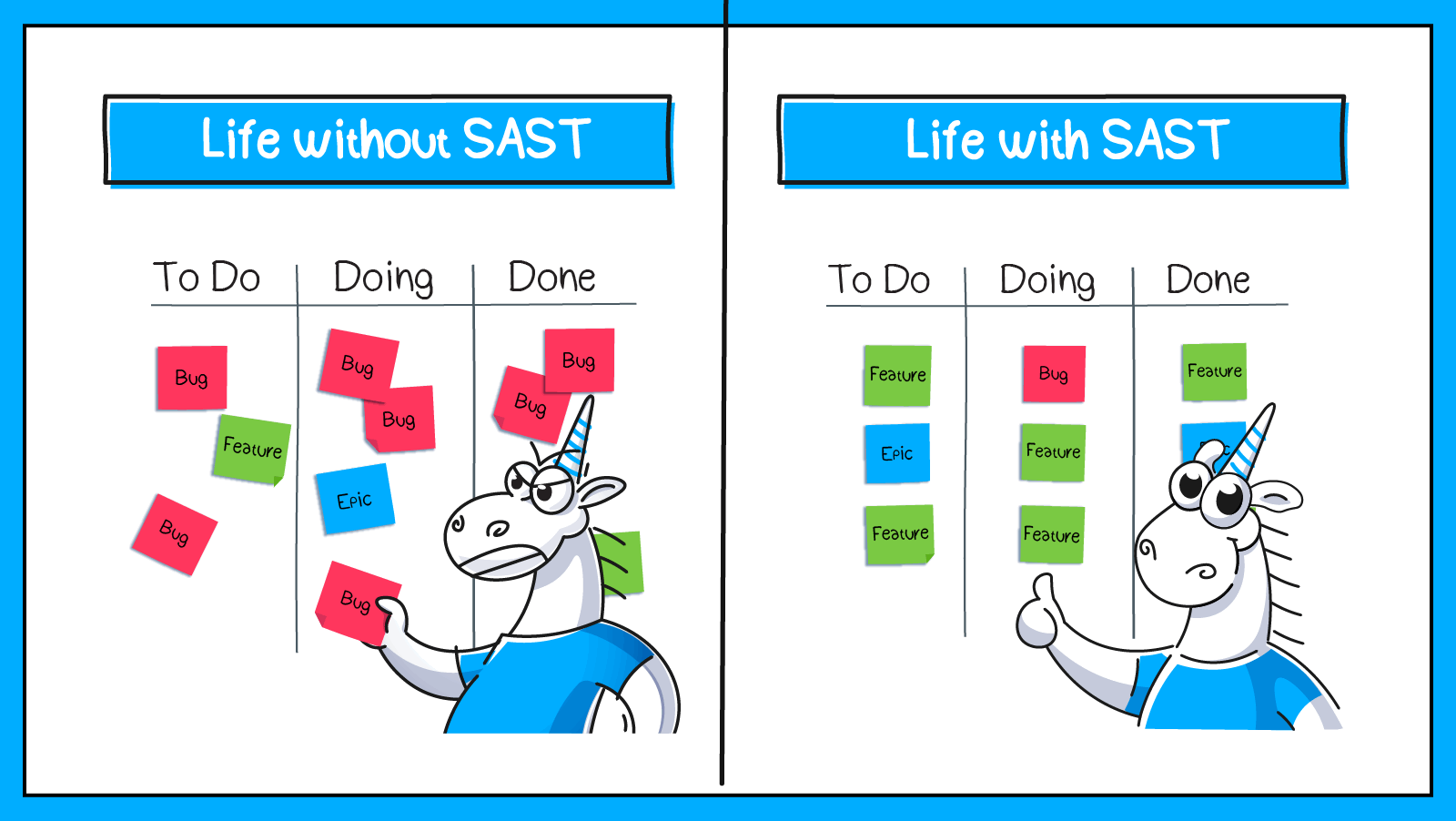
Figure 2. Static Application Security Testing (SAST) makes it possible to focus more on building new features rather than on bugs and vulnerabilities.
The usefulness of static analysis has been proven in practice by large companies. After adopting static analysis for mobile device development, Motorola halved the number of bugs that users discovered during alpha and beta testing [6].
Once a team has spent 50 hours tracking down a bug that the analyzer could have caught right at the start [7].
Research shows that development teams adopting DevSecOps practices with static analysis fix defects 11.5 times faster than those without such practices [8]. Also, implementing static analysis tools doesn't add to the development workload to teams before the release. As developers become more skilled, the false-positive rate drops thanks to cleaner code.
Static analysis is a key component of the Shift Left approach, in which quality checks are moved to earlier stages of development. Implementing static analysis into the CI/CD pipeline enables fixing issues straight away, rather than days or weeks later.
This automates most of the work involved in ensuring compliance with coding standards (MISRA C/C++, SEI CERT, OWASP ASVS) and frees up development time for higher-priority tasks.
Implementing static analysis involves costs: purchasing tools, training the team, and integrating the process, yet these investments pay off. Static analysis tools spot potential vulnerabilities and bugs at a stage when fixing them remains cheap.
Industry research highlights that the ROI from static analysis goes beyond prevented defects and faster regulatory compliance. It also gives teams confidence that they can keep developing the product with a low bug rate [1]. This matters greatly for large-scale projects with a large amount of legacy code.

Figure 3. PVS-Studio.
PVS-Studio is a static code analyzer for C, C++, C#, Java, Go, JavaScript, and TypeScript.
The tool is a classic example of a tool that accelerates the release of high-quality software. By integrating with IDEs and CI/CD systems, PVS-Studio catches bugs and potential vulnerabilities early, saving both budget and time.
Adopting static analysis tools takes resources. Yet asking whether it speeds up time to market without considering quality misses the point. If the goal is simply to ship a product as fast as possible, the quickest route would indeed be to skip all checks.
But when the goal is to deliver a high-quality, reliable, and secure product, static analysis becomes an essential tool for ensuring both quality and security. Using static analysis tools enables you to:
So, a static analyzer is a tool that speeds up development while raising quality. Just like testing, static analysis has become an essential part of professional software development. Its value lies in making the process predictable and the outcome aligned with business and user expectations.


0
0
0


0