
Our website uses cookies to enhance your browsing experience.


The Collins English Dictionary named "vibe coding" as its Word of the Year 2025. This is no surprise: AI has fused so deeply with our routines that the developer community is still debating whether it will replace human developers.
Large enterprises are keeping up with the latest trends. For example, ByteDance has released a 300-page guide to modern AI agents that provides an overview of the best vibe coding practices. Google is close behind with its Christmas advent calendar that offers tips for using Gemini.
What do software engineers and developers think about vibe coding? Is it true that many companies actively implement the tool at the coding stage? Should we genuinely worry that vibe coding will gradually replace real experts in 2026?
PVS-Studio develops a static code analyzer. Code quality and security are the foundation of our product philosophy. We've asked PVS-Studio developers how vibe coding affects these aspects, what they think about this year's main trend, and what they forecast for AI development in 2026.
What were your first impressions of vibe coding?
Mikhail Gelvikh, Technical Support Team Lead: I tried vibe coding for the first time about a year or a half ago. Since then, the methodology has seen great improvements: LLMs now offer better contextual awareness and enhanced compatibility with APIs and documentation. As a result, vibe coding has evolved from a passing fad to a truly handy tool when used carefully.
Viktoriia Trubnikova, DevOps Engineer: I had my first experience with vibe coding a year and a half ago too, when I was just learning how to write automated API tests in Python. Things were going smoothly until I started dealing with rare constructs, complex scripts, and parallel programming—those things caused difficulties.
My SDET friend introduced me to using AI in programming. Although there was no "wow" effect, incorporating AI into the workflow was a pleasant discovery. I didn't study programming conventionally; I learned it through trial and error. Sometimes, I used the "screw around and find out" strategy. Other times, I would just google something or copy it from Stack Overflow.
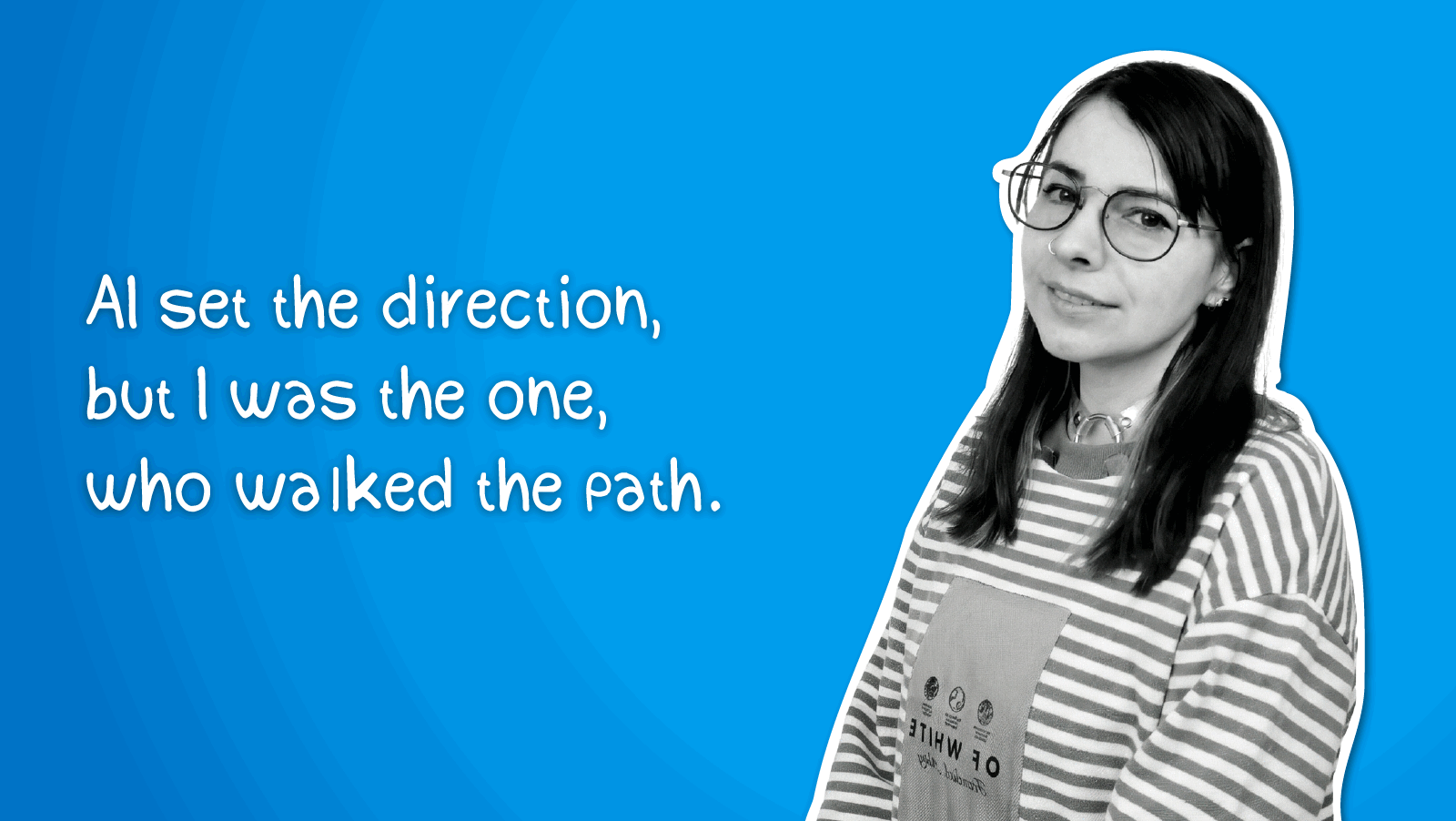
In fact, AI wasn't as advanced back then as it is today, which helped me improve my Python skills. It could solve a simple task almost flawlessly. However, when faced with more complex constructs that I found difficult, AI hardly ever provided any viable solutions. Yet I noticed that it used some constructs I wasn't familiar with, so I started studying them. AI set the direction, but I was the one who followed the path. Although the constructs it suggested were helpful, the model couldn't properly implement them.
Taras Shevchenko, C++ DevOps Engineer: I don't vibe code at all—I don't need it.
Furthermore, using AI can often violate an employment contract and NDA: the employee has agreed not to transfer the company's intellectual property to third parties. Regardless of the vendor, the product code is sent outside the corporate network. This means there's a high probability that it'll be used for AI training. However, local deployment of a particular model can fix this.
At what point does a vibe coder need minimal knowledge of the language, and when does expertise become necessary?
Mikhail Gelvikh, Technical Support Team Lead: I wouldn't recommend "pure" vibe coding because LLMs often give generic responses, so it's important to critically evaluate the results. This requires a good understanding of language semantics, standard libraries, and how architectural decisions impact performance and security. Basic knowledge is enough only for trivial tasks. Writing the correct prompt is another issue. A deep understanding of the subject area is essential in order to get the best results from the AI.
Viktoriia Trubnikova, DevOps Engineer: I think there's nothing wrong with using AI when someone is just getting into software development, provided they genuinely want to learn the fundamentals of a programming language—its quirks and basic syntax—rather than just getting better at communicating with AIs.
When a person copies code they don't understand and asks an AI tool to explain it "like I'm a dummy" or "like I'm a five-year-old," they're just saving the time they'd otherwise spend looking for the same information elsewhere.
Once code no longer looks like gibberish, it's time to learn how to use documentation. Practice is essential to reinforce theory: for example, you can ask AI to assign you a coding task with different inputs. The intermediate level between a junior and mid dev usually requires a good code understanding. The more complex the code, the more errors AI can make. The higher the level, the more challenging the tasks and the more "architectural" approach is required. Current AI systems aren't capable of it, though.
Taras Shevchenko, C++ DevOps Engineer: You can learn the basics of a language in a couple of months, but expertise is always a must. The key difference between a coder and a software engineer is that the latter can articulate (even if in a basic way) what exactly they've done.
Are there any language models that work better than others?
Mikhail Gelvikh, Technical Support Team Lead: These days, AI models update quite frequently, so I usually use a few at once and select the best result.
Viktoriia Trubnikova, DevOps Engineer: I didn't deliberately compare language models, but in my opinion, they all produce equally flawed code. I once tested three different models on the same task, and they all generated unusable stuff. The task wasn't easy, though. Personally, I prefer DeepSeek because it feels more empathetic and helpful, not only with work-related tasks but also with personal issues.
What's more important, a highly advanced language model or a well-written prompt?
Mikhail Gelvikh, Technical Support Team Lead: If I had to choose one, I'd go with the more advanced model. At the same time, clearly defining the task reduces the number of iterations and errors.
Viktoriia Trubnikova, DevOps Engineer: I think it's impossible to choose between a better language model and a well-written prompt. The language model handles understanding, while the prompt provides context.
Taras Shevchenko, C++ DevOps Engineer: Neither option is ideal. Neither solves the problem of limited tokens. A good prompt seems to be the better option. Try telling someone, "I want something, but I don't know what." Of course, they may respond with "I have no idea what you want" because they understand that it's okay to admit uncertainty, but not to lie like AI does.

Do you use vibe coding in your day-to-day work? What challenges does it help to overcome?
Mikhail Gelvikh, Technical Support Team Lead: Not regularly. For me, it's a smart way to learn new technologies and quickly analyze and transform massive data volumes. If any of that generated code ends up in production, it goes through the standard development pipeline, which includes code review, static analysis, testing, and benchmarking. Skipping these steps and relying on such code is far too risky.
Viktoriia Trubnikova, DevOps Engineer: I use AI at work from time to time during crunches, assigning it simple tasks. For example, I might ask it to write a small standalone function or a regular expression.
Is AI a helper or a hindrance?
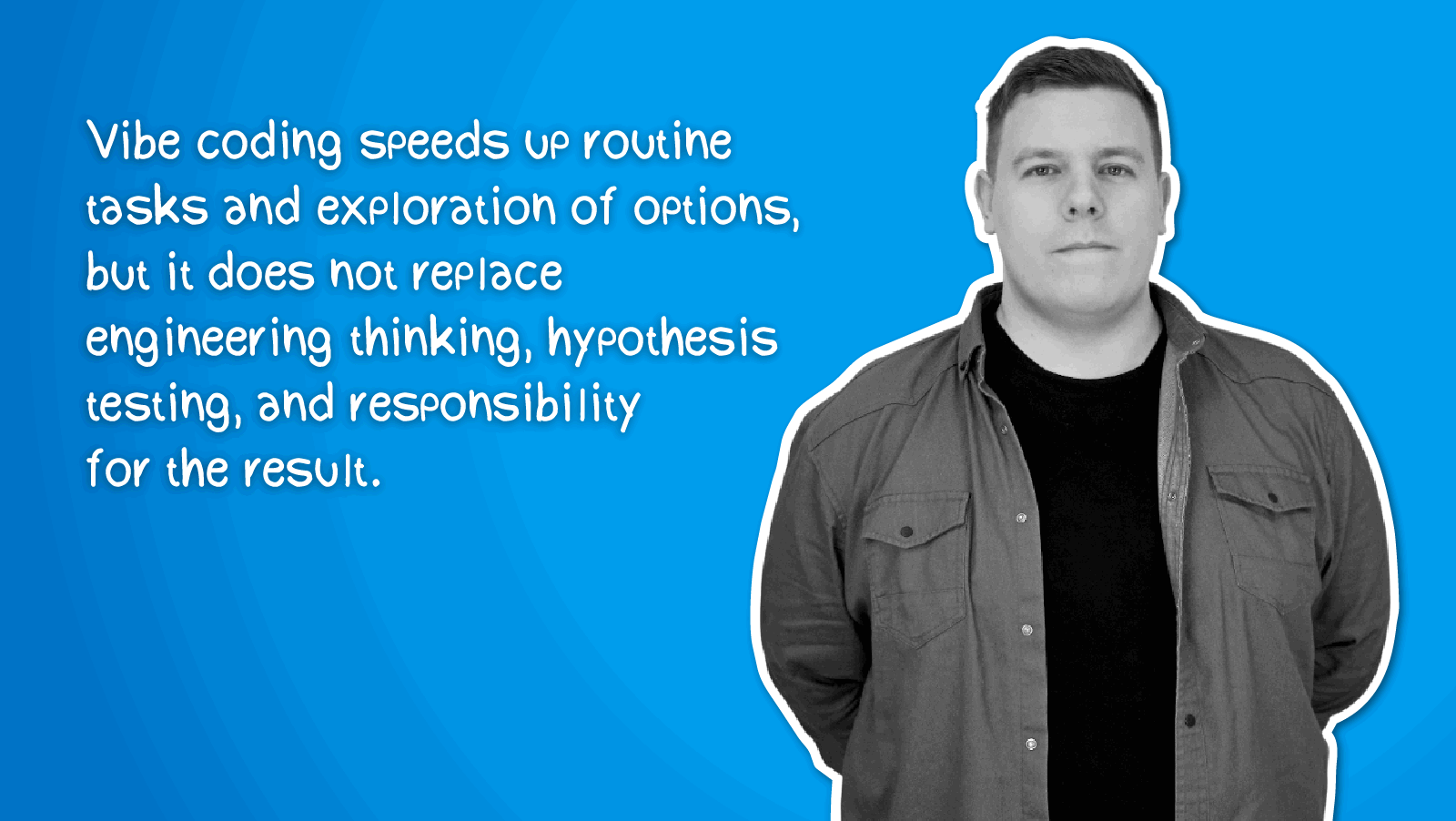
Mikhail Gelvikh, Technical Support Team Lead: I see vibe coding as a helpful tool as long as you have a clear understanding of its limitations and quality control processes in place. Vibe coding speeds up routine work and exploration of options, but it does not replace engineering thinking, hypothesis testing, and responsibility for the result.
Viktoriia Trubnikova, DevOps Engineer: It depends on how you use it, since AI is just a tool. Both the user's skill level and the tool's reliability matter. Another crucial point is recognizing the value of your experience and treating it accordingly. Even before the advent of AI, I think people encountered a similar dilemma with the internet. They could either search for information themselves, analyze it, and use it to create something original or they could just download a ready-made piece and pass it off as their own. In the end, it comes down to conscience and being honest with oneself.
Taras Shevchenko, C++ DevOps Engineer: In my opinion, AI is clearly a hindrance. I see vibe coding as a modern, heavily distorted take on RAD (Rapid Application Development), which was popular in the early 2000s, back when Visual Basic and Delphi dominated the scene. For some reason, applications "drawn" using that approach were more stable and faster than any MVP written by a Tab key enthusiast.
Take a look at computer hardware stores! These days, it's impossible to buy RAM, a graphics card, or even an SSD at a reasonable price! Back in 2017 and 2020, when popular altcoins were soaring, crypto miners did less damage.
Can the widespread use of vibe coding lead to all code becoming AI-based, and developers losing their skills?
Mikhail Gelvikh, Technical Support Team Lead: I think it may push the industry toward a future of the AI-generated code, causing developers to gradually lose their skills. Although models can create working code, it often lacks long-term viability, security, and maintainability. If developers don't deliberately practice, they risk losing their debugging skills, algorithmic thinking, and design instincts.
Viktoriia Trubnikova, DevOps Engineer: I believe that the spread of vibe coding can genuinely lead to AI-generated code flooding the industry. At the same time, the growth of real expertise will halt, and traditional developers—those who didn't "lose their minds" during the vibe coding boom—will be in high demand.
Taras Shevchenko, C++ DevOps Engineer: The spread of vibe coding is starting to make the code highly fragmented. As a result, developers are struggling to grow their expertise and are eventually losing their real, hands-on engineering skills.
Even when only human developers wrote code, we had to deal with a long list of problems. Now with vibe coders in the mix, we're faced with monstrous constructs that consume already expensive memory not just exponentially, but at a geometric rate.
What are the risks of widespread AI use in programming?
Mikhail Gelvikh, Technical Support Team Lead: We'll see more and more low-quality software that kind of works. We should also remember that LLMs are prone to various security issues.
Viktoriia Trubnikova, DevOps Engineer: Potential experts will lose their skills, and code quality will decline.
Taras Shevchenko, C++ DevOps Engineer: Software quality is declining. Unfortunately, that's just how things are now. AI has accelerated this trend by prioritizing speed for immediate business tasks, often just to meet the high KPIs set by managers. Back in the day, people would look for clever workarounds on their own. Now, they can't even be bothered to cut corners; they just let AI do it for them.
What's your prediction for vibe coding next year? Will this approach evolve further, or will it be obsolete by the end of 2026?
Mikhail Gelvikh, Technical Support Team Lead: I think vibe coding is here to stay because it can be very beneficial when used wisely. News about the growing shortage of hardware components for continuous AI training raises certain doubts, but we'll see the effects of this later.
Viktoriia Trubnikova, DevOps Engineer: I suppose that it'll resemble the early days of the internet. At first, people will be impressed, but then they'll get used to it and start to see its pros and cons. Then, critical thinking and the ability to sensibly assess its impact on processes will kick in.
I believe that vibe coding will evolve and improve; it'll integrate into other information systems at a similar pace as other components. The overhype will eventually die down.
Taras Shevchenko, C++ DevOps Engineer: Speculating about evolution of vibe coding and its widespread adoption in routine workflows, I think it'd be better to "boil the frog slowly". At the moment, the water is only heating up, but it's close to boiling. The real question is who will cut the heat first: the frustrated end user who can no longer afford a computer because of it; the investors whose money has been burned up while chasing the hype; or the leadership, who will be left in a deeply awkward position once the real reason for the collapse of their project comes out?
We asked ChatGPT...
...how it sees the future of vibe coding. Yeah, the question is a bit ironic. Plus, AI generates responses from open-source texts, but still.
ChatGPT concludes, "The hype will die down, but the approach will remain and spread."
Among other responses, AI confidently promotes the idea that vibe coding will stop being a meme and join a roster of basic development practices. Judging by this response, artificial intelligence has made significant progress in terms of self-esteem. One thing is clear: it would be wise to think twice before making fun of "soulless machines" in the new year :)


0
0
0

 38
38
 0
0

0