# Analyzing the code quality of Microsoft's Open XML SDK
My first encounter with Open XML SDK took place when I was looking for a library that I could use to create some accounting documents in Word\. After more than 7 years of working with Word API, I wanted to try something new and easier\-to\-use\. That's how I learned that Microsoft offered an alternative solution\. As tradition has it, before our team adopts any program or library, we check them with the PVS\-Studio analyzer\.
## Introduction
Office Open XML, also known as OpenXML or OOXML, is an XML\-based format for representing office documents, including text documents, spreadsheets, presentations, as well as charts, figures, and other types of graphical content\. The specification was developed by Microsoft and approved by ECMA International in 2006\. In June 2014, Microsoft released Open XML SDK as an open\-source project\. The source files are currently available on [GitHub](https://github.com/OfficeDev/Open-XML-SDK) under the MIT license\.
I scanned the library's source code with the static analyzer [PVS\-Studio](https://pvs-studio.com/en/pvs-studio/)\. This is a tool for detecting software bugs and potential vulnerabilities in the source code of programs in C, C\+\+, C\#, and Java\. The analyzer runs on 64\-bit Windows, Linux, and macOS\.
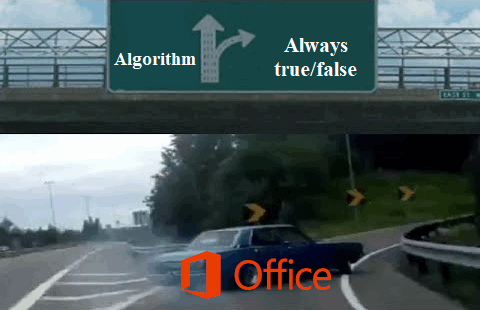
The project is fairly small, so the number of warnings is small too\. But they were prominent enough to inspire my choice of the image for this post\. You see, there are too many useless conditional statements in this project\. I believe that refactoring all such spots would help make the code much shorter and therefore clearer\.
## Why still Word API and not Open XML SDK?
As you have guessed from this title, I'm still using Word API in my work\. There are a lot of downsides to this approach:
* The API is old and cumbersome;
* You have to have Microsoft Office installed on your computer;
* You have to ship the distribution with the Office libraries included;
* Word API's operation depends on the system's locale settings;
* Low performance\.
There's a funny story concerning the locale in particular\. Windows provides a dozen of regional settings\. We found that one of our servers was for some reason using a mishmash of the USA and UK locales, which caused our Word documents to substitute the ruble sign for the dollar sign, while the pound sign wasn't displayed at all\. We solved the problem by tweaking the system's settings\.
Now as I'm telling you all this, I'm once again asking myself why I keep using it\.\.\.\.
But no, I still like Word API more, and I'll tell you why\.
Here's what OOXML format looks like:
```cpp
This is a paragraph.
This is another paragraph.
```
Here, _ \(Word Run\)_ is not a sentence or even a word – it's any block of text whose attributes are different from those of adjacent blocks\.
This is programmed through code that looks something like this:
```cpp
Paragraph para = body.AppendChild(new Paragraph());
Run run = para.AppendChild(new Run());
run.AppendChild(new Text(txt));
```
A document has its own special inner structure, and the same elements must be created in the code\. In my opinion, the abstraction level of data access in Open XML SDK isn't deep enough\. Creating a document using Word API is more comprehensible and takes less time – especially when you deal with spreadsheets and other complex data structures\.
On the other hand, Open XML SDK helps solve a wide range of tasks\. It can be used to create not only Word documents but Excel and PowerPoint documents as well\. This library might well be a more preferable choice for some tasks, but I've decided to stick with Word API for now\. We can't abandon Word altogether anyway since we are developing a plugin for Word for our corporate needs, and this task can be accomplished only using the Word API\.
## Two values of string
[V3008](https://pvs-studio.com/en/docs/warnings/v3008/) The '\_rawOuterXml' variable is assigned values twice successively\. Perhaps this is a mistake\. Check lines: 164, 161\. OpenXmlElement\.cs 164
```cpp
internal string RawOuterXml
{
get => _rawOuterXml;
set
{
if (string.IsNullOrEmpty(value))
{
_rawOuterXml = string.Empty;
}
_rawOuterXml = value;
}
}
```
The _string_ type can have two types of values: _null_ and a text value\. To use the latter is definitely a safer approach, but either is acceptable\. In this particular project, the _null_ value can't be used and the programmer overwrites it with _string\.Empty_\.\.\. at least, that was the idea\. There's a mistake in _RawOuterXml_ that makes it possible to assign the value _null _to the field and then get a _NullReferenceException_ when attempting to access it\.
[V3022](https://pvs-studio.com/en/docs/warnings/v3022/) Expression 'namespaceUri \!\= null' is always true\. OpenXmlElement\.cs 497
```cpp
public OpenXmlAttribute GetAttribute(string localName, string namespaceUri)
{
....
if (namespaceUri == null)
{
// treat null string as empty.
namespaceUri = string.Empty;
}
....
if (HasAttributes)
{
if (namespaceUri != null) // <=
{
....
}
....
}
....
}
```
The same approach is used in this snippet as well\. It's not a severe mistake, but you can still smell the bad refactoring\. I'm almost sure one of the checks can be safely removed – that would make the code narrower and therefore easier to read\.
## On code compactness
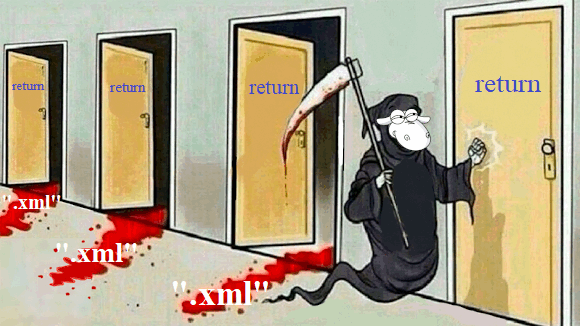
[V3009](https://pvs-studio.com/en/docs/warnings/v3009/) It's odd that this method always returns one and the same value of '"\.xml"'\. CustomXmlPartTypeInfo\.cs 31
```cpp
internal static string GetTargetExtension(CustomXmlPartType partType)
{
switch (partType)
{
case CustomXmlPartType.AdditionalCharacteristics:
return ".xml";
case CustomXmlPartType.Bibliography:
return ".xml";
case CustomXmlPartType.CustomXml:
return ".xml";
case CustomXmlPartType.InkContent:
return ".xml";
default:
return ".xml";
}
}
```
I'm not sure if the programmer made some typo or simply wrote what they believed to be "neat" code\. If you ask me, it doesn't make much sense to return so many similar values and the code can be simplified quite a bit\.
It's not the only warning of this type\. Here are two more:
* V3009 It's odd that this method always returns one and the same value of '"\.xml"'\. CustomPropertyPartTypeInfo\.cs 25
* V3009 It's odd that this method always returns one and the same value of '"\.bin"'\. EmbeddedControlPersistenceBinaryDataPartTypeInfo\.cs 22
I wonder how the programmer would explain their decision to write the code that way\.
[V3139](https://pvs-studio.com/en/docs/warnings/v3139/) Two or more case\-branches perform the same actions\. OpenXmlPartReader\.cs 560
```cpp
private void InnerSkip()
{
Debug.Assert(_xmlReader != null);
switch (_elementState)
{
case ElementState.Null:
ThrowIfNull();
break;
case ElementState.EOF:
return;
case ElementState.Start:
_xmlReader.Skip();
_elementStack.Pop();
GetElementInformation();
return;
case ElementState.End:
case ElementState.MiscNode:
// cursor is end element, pop stack
_xmlReader.Skip();
_elementStack.Pop();
GetElementInformation();
return;
....
}
....
}
```
This snippet is less controversial than the previous one\. I think the identical cases can be merged to make the code shorter and clearer\.
Here are a few more issues of that kind:
* V3139 Two or more case\-branches perform the same actions\. OpenXmlMiscNode\.cs 312
* V3139 Two or more case\-branches perform the same actions\. CustomPropertyPartTypeInfo\.cs 30
* V3139 Two or more case\-branches perform the same actions\. CustomXmlPartTypeInfo\.cs 15
* V3139 Two or more case\-branches perform the same actions\. OpenXmlElement\.cs 1803
## The infamous always true/false
We have finally reached the section covering examples that determined my choice of the picture for this article\.
**Warning 1**
[V3022](https://pvs-studio.com/en/docs/warnings/v3022/) Expression 'Complete\(\)' is always false\. ParticleCollection\.cs 243
```cpp
private bool IsComplete => Current is null ||
Current == _collection._element.FirstChild;
public bool MoveNext()
{
....
if (IsComplete)
{
return Complete();
}
if (....)
{
return Complete();
}
return IsComplete ? Complete() : true;
}
```
The _IsComplete_ property is used twice, and it's clear from the code that the property's value won't change between the two checks\. It means you can have the function simply return the second value of the ternary operator, i\.e\. _true_\.
**Warning 2**
[V3022](https://pvs-studio.com/en/docs/warnings/v3022/) Expression '\_elementStack\.Count \> 0' is always true\. OpenXmlDomReader\.cs 501
```cpp
private readonly Stack _elementStack;
private bool MoveToNextSibling()
{
....
if (_elementStack.Count == 0)
{
_elementState = ElementState.EOF;
return false;
}
....
if (_elementStack.Count > 0) // <=
{
_elementState = ElementState.End;
}
else
{
// no more element, EOF
_elementState = ElementState.EOF;
}
....
}
```
If the number of elements on the _\_elementStack_ stack is different from 0, then it's obviously larger than 0\. It means the code can be made at least 8 lines shorter\.
**Warning 3**
[V3022](https://pvs-studio.com/en/docs/warnings/v3022/) Expression 'rootElement \=\= null' is always false\. OpenXmlPartReader\.cs 746
```cpp
private static OpenXmlElement CreateElement(string namespaceUri, string name)
{
if (string.IsNullOrEmpty(name))
{
throw new ArgumentException(....);
}
if (NamespaceIdMap.TryGetNamespaceId(namespaceUri, out byte nsId)
&& ElementLookup.Parts.Create(nsId, name) is OpenXmlElement element)
{
return element;
}
return new OpenXmlUnknownElement();
}
private bool ReadRoot()
{
....
var rootElement = CreateElement(....);
if (rootElement == null) // <=
{
throw new InvalidDataException(....);
}
....
}
```
The _CreateElement_ function can't return _null_\. If the company has adopted the rule that xml nods be created using methods that either return a valid object or throw an exception, users that employ these methods don't have to overuse additional checks\.
**Warning 4**
[V3022](https://pvs-studio.com/en/docs/warnings/v3022/) Expression 'nameProvider' is always not null\. The operator '?\.' is excessive\. OpenXmlSimpleTypeExtensions\.cs 50
```cpp
public static XmlQualifiedName GetSimpleTypeQualifiedName(....)
{
foreach (var validator in validators)
{
if (validator is INameProvider nameProvider &&
nameProvider?.QName is XmlQualifiedName qname) // <=
{
return qname;
}
}
return type.GetSimpleTypeQualifiedName();
}
```
Here is the pattern of the _is_ operator:
```cpp
expr is type varname
```
If the result of the _is_ expression is _true_, a nonnull reference will be written in _varname_\. So its additional check for _null_ is redundant\.
**Warning 5**
[V3022](https://pvs-studio.com/en/docs/warnings/v3022/) Expression 'extension \=\= "\.xlsx" \|\| extension \=\= "\.xlsm"' is always false\. PresentationDocument\.cs 246
```cpp
public static PresentationDocument CreateFromTemplate(string path)
{
....
string extension = Path.GetExtension(path);
if (extension != ".pptx" && extension != ".pptm" &&
extension != ".potx" && extension != ".potm")
{
throw new ArgumentException("...." + path, nameof(path));
}
using (PresentationDocument template = PresentationDocument.Open(....)
{
PresentationDocument document = (PresentationDocument)template.Clone();
if (extension == ".xlsx" || extension == ".xlsm")
{
return document;
}
....
}
....
}
```
This is quite an interesting case\. The programmer first filters off all documents whose extensions are different from _\.pptx_, _\.pptm_, \._potx_, and \._potm_, and then – just in case – decides to make sure there are no _\.xlsx_ and _\.xlsm_ documents left among those\. The _PresentationDocument_ function is definitely a victim of refactoring\.
**Warning 6**
[V3022](https://pvs-studio.com/en/docs/warnings/v3022/) Expression 'OpenSettings\.MarkupCompatibilityProcessSettings \=\= null' is always false\. OpenXmlPackage\.cs 661
```cpp
public MarkupCompatibilityProcessSettings MarkupCompatibilityProcessSettings
{
get
{
if (_mcSettings is null)
{
_mcSettings = new MarkupCompatibilityProcessSettings(....);
}
return _mcSettings;
}
set
{
_mcSettings = value;
}
}
public MarkupCompatibilityProcessSettings MarkupCompatibilityProcessSettings
{
get
{
if (OpenSettings.MarkupCompatibilityProcessSettings == null) // <=
{
return new MarkupCompatibilityProcessSettings(....);
}
else
{
return OpenSettings.MarkupCompatibilityProcessSettings;
}
}
}
```
The _MarkupCompatibilityProcessSettings_ property never returns _null_\. If the getter finds that the class's field has the _null_ value, the object will be overwritten with a new one\. Also, note that this is not a recursive call of one and the same property but rather properties of the same name from different classes\. This confusion may have caused the developer to add the extra checks\.
## Other warnings
**Warning 1**
[V3080](https://pvs-studio.com/en/docs/warnings/v3080/) Possible null dereference\. Consider inspecting 'previousSibling'\. OpenXmlCompositeElement\.cs 380
```cpp
public OpenXmlElement PreviousSibling()
{
if (!(Parent is OpenXmlCompositeElement parent))
{
return null;
}
....
}
public override T InsertBefore(T newChild, OpenXmlElement referenceChild)
{
....
OpenXmlElement previousSibling = nextNode.PreviousSibling();
prevNode.Next = nextNode;
previousSibling.Next = prevNode; // <=
....
}
```
Contrary to the previous examples, this one does require an additional check\. The _PreviousSibling_ method _can _return the value _null_, and it will be used right away without any check\.
Two more potential null dereferences:
* V3080 Possible null dereference\. Consider inspecting 'prevNode'\. OpenXmlCompositeElement\.cs 489
* V3080 Possible null dereference\. Consider inspecting 'prevNode'\. OpenXmlCompositeElement\.cs 497
**Warning 2**
[V3093](https://pvs-studio.com/en/docs/warnings/v3093/) The '&' operator evaluates both operands\. Perhaps a short\-circuit '&&' operator should be used instead\. UniqueAttributeValueConstraint\.cs 60
```cpp
public override ValidationErrorInfo ValidateCore(ValidationContext context)
{
....
foreach (var e in root.Descendants(....))
{
if (e != element & e.GetType() == elementType) // <=
{
var eValue = e.ParsedState.Attributes[_attribute];
if (eValue.HasValue && _comparer.Equals(....))
{
return true;
}
}
}
....
}
```
Some developers love applying the '&' operator to logical expressions without good reason\. But whatever value its first operand evaluates to, the second operand will be evaluated anyway\. In this particular case, it's not a critical mistake, but such careless code may start throwing _NullReferenceException_s after refactoring\.
**Warning 3**
[V3097](https://pvs-studio.com/en/docs/warnings/v3097/) Possible exception: type marked by \[Serializable\] contains non\-serializable members not marked by \[NonSerialized\]\. OpenXmlPackageValidationEventArgs\.cs 15
```cpp
[Serializable]
[Obsolete(ObsoleteAttributeMessages.ObsoleteV1ValidationFunctionality, false)]
[EditorBrowsable(EditorBrowsableState.Never)]
public sealed class OpenXmlPackageValidationEventArgs : EventArgs
{
private string _message;
[NonSerialized]
private readonly object _sender;
[NonSerialized]
private OpenXmlPart _subPart;
[NonSerialized]
private OpenXmlPart _part;
....
internal DataPartReferenceRelationship
DataPartReferenceRelationship { get; set; } // <=
}
```
Serialization of the _OpenXmlPackageValidationEventArgs_ class may fail because one of the properties is not marked as _serializable_\. Alternatively, this can be fixed by making the property's return type serializable; otherwise, you risk getting an exception at runtime\.
## Conclusion
We, PVS\-Studio developers, are fans of Microsoft projects and technologies\. We even have a separate section dedicated to Microsoft on our page listing all open\-source projects [checked](https://pvs-studio.com/en/blog/inspections/) with PVS\-Studio\. That section already includes 21 projects covered in 26 articles\. This one is the 27th\.
I bet you are wondering if Microsoft is our client\. Yes, it is\! But keep in mind it's a huge corporation operating all over the world\. Some of its subdivisions surely use PVS\-Studio in their work, but many more don't\! As our experience with open\-source projects shows, the latter are obviously in need of a good bug\-detecting tool ;\)\.
[](https://pvs-studio.com/en/pvs-studio-download/)
Those who follow news on analysis of C\+\+, C\#, and Java code may also be interested to know that we have recently added support of the [OWASP](https://pvs-studio.com/en/pvs-studio/sast/owasp/) standard and are actively covering it with our diagnostics\.